Since 2021, international headlines about Afghanistan have been dominated by a familiar narrative: restrictions, conflict, and humanitarian crises. While these challenges are undeniably real and deeply devastating, this singular focus overlooks another essential part of Afghanistan’s story.
We are missing the story of Afghan women and girls – their courage, resilience, and determination. These are women and girls whose fundamental rights have been stripped away; who have been told they cannot go to school, cannot work, and cannot move freely in their own communities.
Nearly five years have passed since Afghanistan’s political landscape changed. It is time for the global conversation to change as well. Alongside the stories of oppression and crisis, we must also recognize the resilience, ingenuity, and unwavering determination of Afghan women and girls who continue to fight for their right to learn, to lead, and to shape their own futures.
The Five Years: A Story of Adaptation
The years between 2021 and 2026 have been defined by profound change, uncertainty, and displacement. But they have also been defined by adaptation and resilience. When physical doors closed, Afghan youth found digital windows. As opportunities disappeared at home, they built new ones online. We have witnessed the rise of global diaspora networks advocating on the international stage, the expansions of borderless education, and the emergence of new forms of civic engagement and resistance. The story of these five years is not only about what was taken away, but also about how Afghans, both inside the country and across the world, adapted, supported one another, and refused to let hope disappear.
Public conversations too often portray Afghans solely through the lens of crisis and victimhood. This overlooks the agency and resilience of the Afghan people, particularly its youth. They have not been passive witnesses to their history. They have preserved their culture, continued to seek education against all odds, built new networks across borders, and found innovative ways to lead and advocate for their communities.
As we reflect on the past five years, we must move beyond asking only what Afghanistan has lost. We must also ask what Afghans have preserved, what they have created, and how they have reimagined their futures in the face of immense adversity. Most importantly, we must ask what kind of future they seek to build, and how the international community can help ensure they have the opportunity to build it.
The Five Voices: The Harsh Reality
Afghanistan is now ranked as one of the most difficult places in the world for women and girls to live and thrive. The country is facing a severe public health crisis, with maternal mortality reaching approximately 600 deaths per 100,000 live births. If current restrictions persist, UNICEF warns that Afghanistan could lose over 25,000 female teachers and healthcare workers by 2030.
Deprived of their rights to education, employment, and participation in public life, many Afghan women are facing profound psychological distress as they endure increasing isolation, uncertainty, and lose of opportunity. Suicide attempts and suicide rates among females have been rising, with many unreported.
To understand the human impact of this crisis, we share below the stories of five young girls living through these extraordinary circumstances in Afghanistan. These are not abstract discussions about hope or resilience; these are honest and difficult accounts of what it means to have a future disrupted and opportunities taken away. They speak of the isolation of remaining at home while their brothers attend school. They speak of the fears and restrictions that shape their daily lives. They describe what it feels like to watch long-held dreams become increasingly difficult to reach.
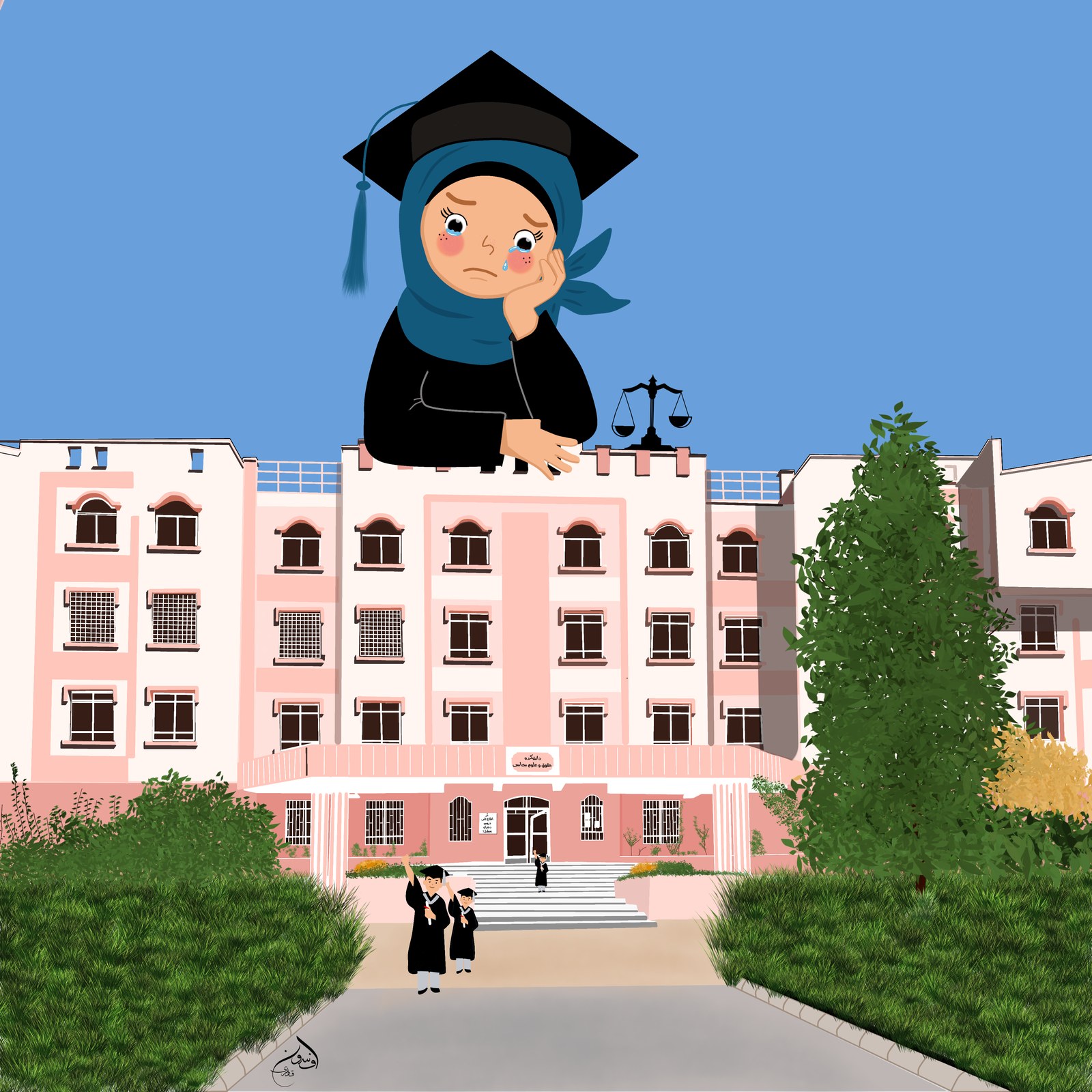
Fatima writes how she still remembers that day when she was late to rise because she studied all night. It was her dream to become a lawyer. “Two months ago, I got accepted into a university and it was the happiest moment of my life. This was before the Taliban banned women from acquiring higher education. That day, when I woke up with the news of a ban on universities for girls, I knew that my future collapsed at that very moment.” Fatima still keeps her books with herself but only as reminders of what she has lost.
Maryam, another young woman from Herat province in Afghanistan writes, “I received a scholarship to study abroad but I could not travel to a third country to complete my visa process because girls and women are banned from traveling inside and outside of Afghanistan without a male companion. I didn’t have a brother and my father was old so I felt I was trapped and my opportunity was lost.” This was not because of her ability or determination but because she could not cross the border to reach a consular office.
Nosheen, another girl in Badakhshan province shares: “I vividly recall my last day in grade six as it was the final time I sat in a classroom and watching my friends and teachers with eyes full of tears. The Taliban don’t allow girls to go to school after 6th grade and I knew it meant the end of my education.” She describes how she saw her dreams slip away that day and knowing that she will be staying at home with a quiet hope that one day the doors of education will open again.
Sahar, a young woman from Kabul, writes: “I used to work in a small tailoring shop to support my family but after the restrictions, the shop owner told me I could no longer come to work. That very day, I lost my income and my family lost the only money we had for food.” Sahar’s story shows how girls and women like her who lost her job feel helpless now not because they don’t want to work but because I am forbidden from doing so.
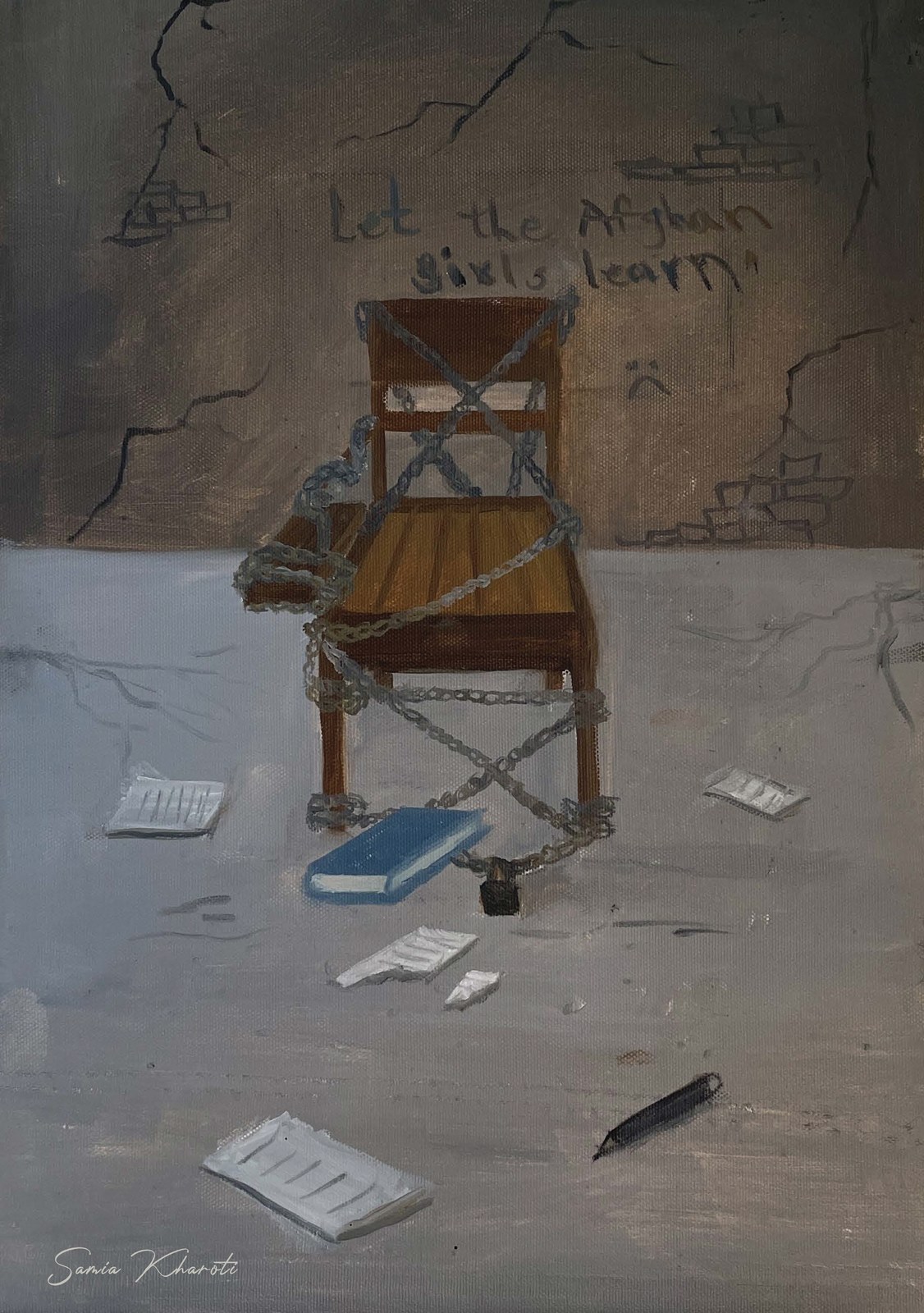
Zahra, from Ghazni province, shares: “I used to play volleyball with my friends in a small community club because sport give me and other girls confidence and a sense of freedom but with fall of Afghanistan and return of the Taliban, our club was shut down and we were told girls cannot play in public anymore. I still keep my volleyball at home but I cannot use it.” This is not just about losing a sport for many girls like Zahra, it is losing one of the spaces where they felt strong, happy, and part of a community.
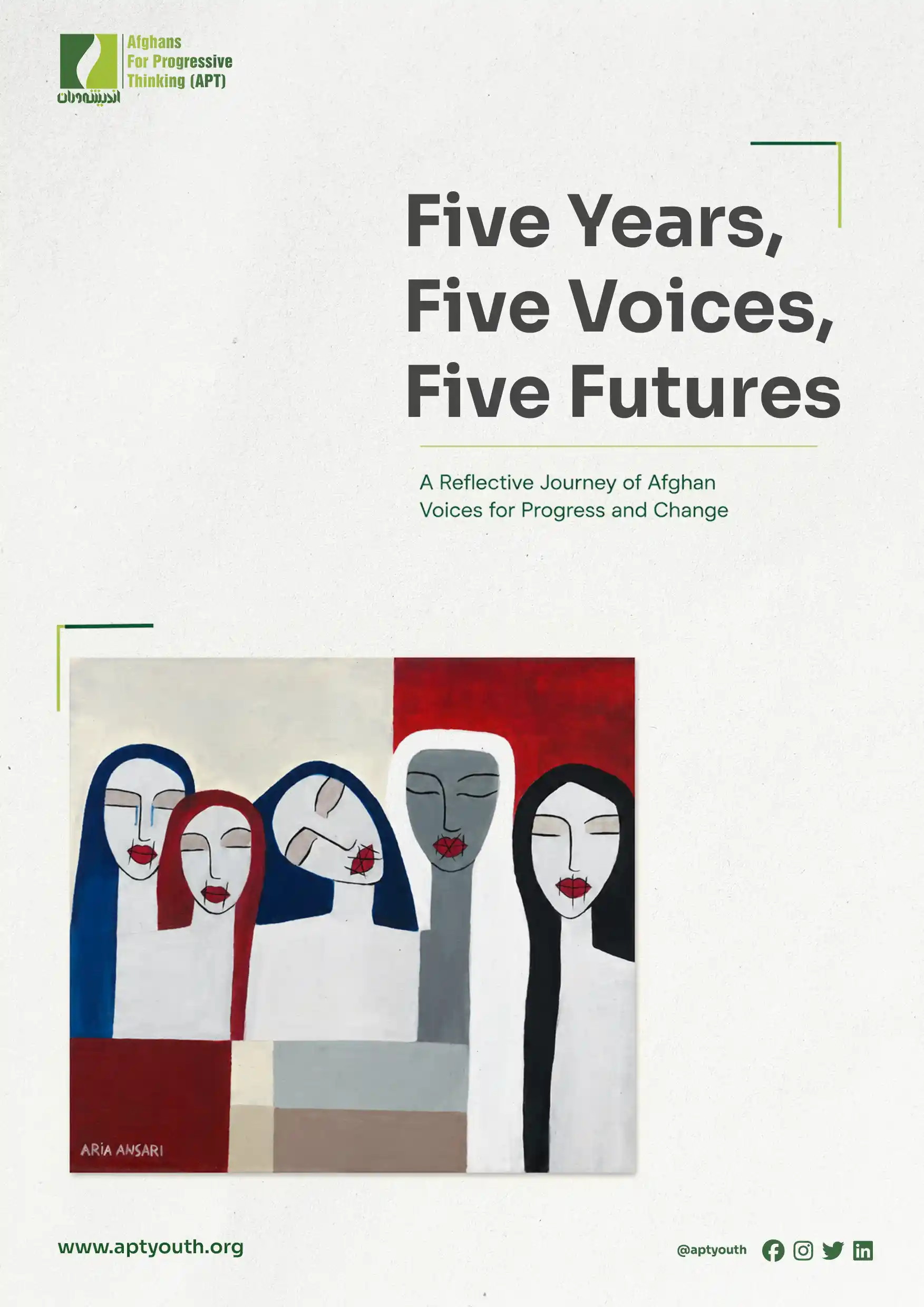
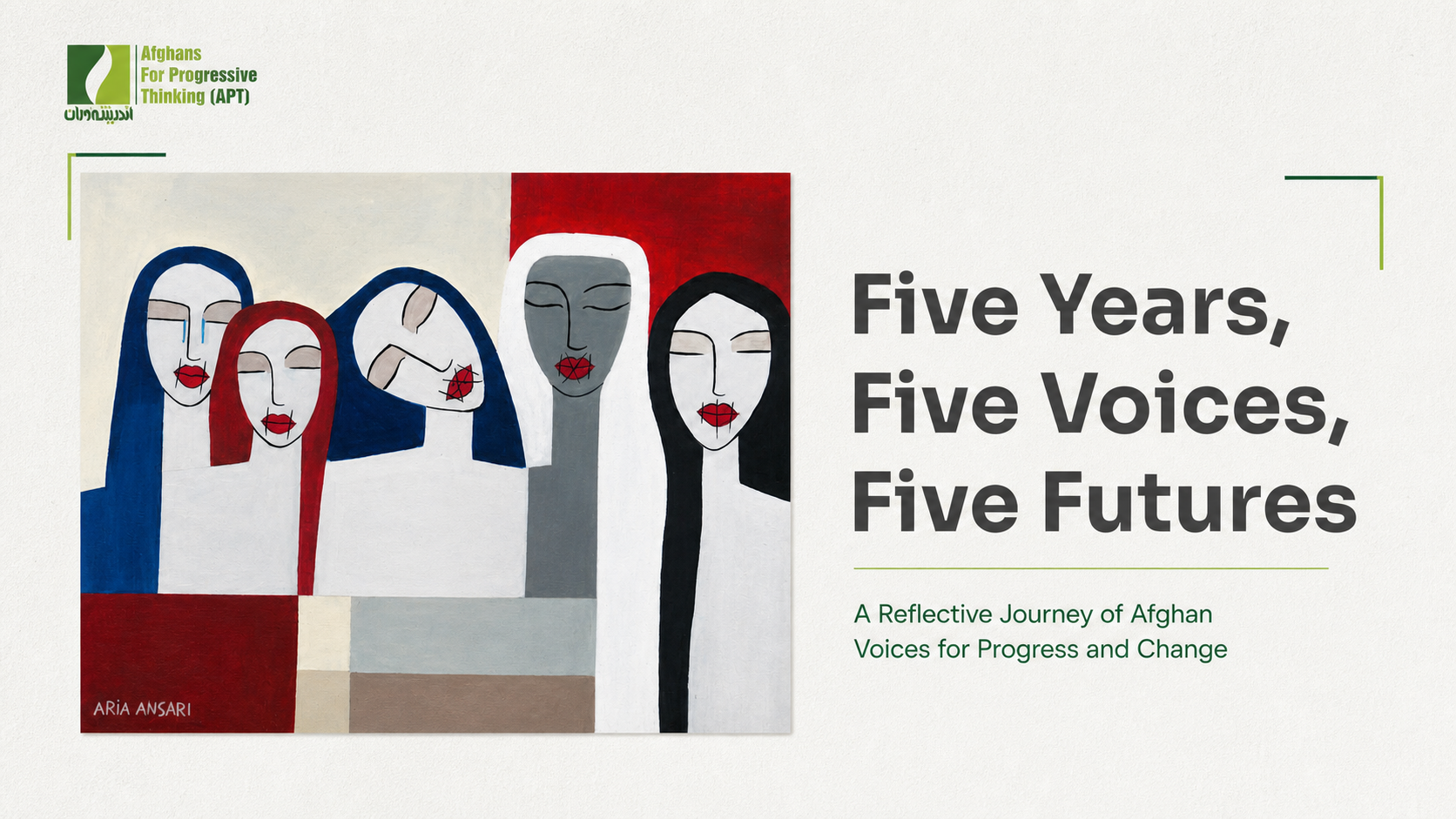
Because speaking out is often dangerous, we must also find other ways to listen to their voices. Art has become a powerful form of expression and survival. Through the artwork created by Afghan girls, we can witness emotions and experiences that cannot always be spoken aloud – the grief, frustration, uncertainty, and quiet acts of resistance that exist beneath the surface. These five voices, through both their words and their art, represent millions of girls whose experiences remain largely unheard. They call on the world to see, understand, and respond to the realities they face.
The Five Futures: The Pathways Out
We know the problem, and we know the solution. The gap between the five voices trapped in Afghanistan and the five futures of women who have found a pathway forward is opportunity – specifically, the opportunity of education.
This is what “Five Futures” represents. We highlight five APT members who secured university admissions or scholarships, while some continue to face barriers to reaching their destinations. These women are living proof that educational pathways can create opportunities for Afghan women to rebuild their futures. By sharing their personal journeys as refugees and newcomers, they offer both inspiration and a practical roadmap for others seeking the same possibility.
These five women share how they navigated the complex process of finding international scholarships, securing visas, and making the difficult decision to leaving their families behind. They speak about the challenges of adapting to unfamiliar education systems, rebuilding their lives in new countries, and starting over from nothing. Their stories are not just inspiring; they are practical guides, which demonstrate the steps, obstacles, and opportunities involved in moving from a place of restriction toward a future of greater freedom and possibility.
Rahila Haidari received a full scholarship to Germany and is now awaiting her visa in Tajikistan. Her perseverance shows how education can carry Afghan girls beyond restrictions, giving them dignity and hope even in exile.
Samira Hayati obtained admission to four Italian universities and chose to study Economics and Management in Milan. Her achievement shows how determination and hope can open doors to new futures, even after years of challenges, restrictions, and uncertainty.
Safia Behzad won a scholarship to continue her education in Indonesia after the closure of universities in Afghanistan for girls and women. For five years she applied, facing rejection after rejection, yet she never gave up. Today, she prepares to begin her master’s degree. This is not just an academic opportunity for her, but a result of years of perseverance. She proves that Afghan women, when given even one chance, will work to transform it into hope and possibility.
Arzoo Ahmadi earned scholarships in Italy twice, showing her determination to keep working hard despite obstacles. During her first opportunity, her visa appointment was cancelled because of regional conflict. During her second, closed borders made the process nearly impossible but she never stopped applying and never stopped believing that her education mattered. She showed how Afghan women’s talent and commitment can break through barriers even when circumstances block the way.
Soman Rahimi was admitted to universities in the U.S., Canada, and Europe, and received multiple scholarships through her hard work, long nights studying English on an unreliable laptop, power outages, and the struggle to afford exam fees. Even when visa barriers delayed her plans, she showed that Afghan women can achieve so much despite restrictions and challenges. Her success is not only personal, it reminds us that Afghan women’s talent is recognized globally and that keeping pathways open is vital for turning their hard‑won opportunities into futures of freedom and possibility.
Listening to these difficult stories is necessary, but it is only the first step. We cannot ask girls to share their pain without also creating pathways forward. For many Afghan girls, access to education represents not only an academic opportunity, but a lifeline – a pathway to safety, independence, and a future they have the right to pursue.
The international community must transform solidarity into action. Governments should strengthen pathways for Afghan students by creating more accessible visa processes and ensuring that educational opportunities are not lost because of administrative barriers. The international community should recognize and respond to the systematic exclusion of women and girls from public life – officially codify “gender apartheid” as a crime against humanity under international law, establishing clear legal avenues to prosecute Taliban leaders and ensuring women’s rights are a non-negotiable condition of any diplomatic engagement. Global donors must rethink traditional funding models and provide flexible, direct support to grassroots and women-led organizations sustaining education and support networks. We need universities around the world to expand dedicated scholarships for Afghan women, while citizens and community leaders can learn practical advocacy tools to support refugee pathways and educational access.
If you want to help, there are meaningful ways to act. You can mentor an Afghan student navigating the complex process of applying to international universities. You can support organizations helping refugees and newcomers build lives in their host communities. You can write to your local representatives and advocate for visa pathways that allow students fleeing conflict to continue their education.
Education created the first pathway forward for these women. Together we can help ensure it remains open for the many others still waiting.
References
- Kazim Jafari. “The Rise of the Afghan Diaspora as a Political Powerhouse.” Afghan Diaspora Network, April 13, 2026.
- UNICEF Data. “Maternal Mortality Rates and Statistics.” Last modified April 9, 2025; accessed July 27, 2026.
- WHO EMRO – Afghanistan’s National Health Strategy 2026–2030 aims to improve the quality and sustainability of health services
- Afghanistan: Humanitarian Update, June 2026 | OCHA